
Here’s something most companies in this industry won’t say plainly: if someone promises “100% mold removal,” they’re promising something science doesn’t allow. Mold spores exist naturally in all air, indoors and out. You’re breathing some right now, and that’s normal and harmless.
So why do “mold removal” and “mold remediation” both exist, and why does the difference matter to you? Because one is mostly a marketing phrase, and the other is a defined professional process with standards, verification, and a lasting result. Knowing the difference protects you from companies that spray, paint, and disappear.
Here’s what each term really means, what professional mold remediation actually involves, and how to tell who’s doing it right.
Quick Answer
Mold removal refers to physically eliminating mold from surfaces, but complete removal of all mold spores is impossible because spores occur naturally in all air. Mold remediation is the professional process of returning mold to normal, healthy levels. It involves identifying the moisture source, implementing containment, removing contaminated materials, performing HEPA cleaning, and verifying the results. Remediation is the industry-standard term, and fixing the moisture problem is what makes it permanent.
What Is Mold Removal?
Mold remediation is the professional process of returning a mold-contaminated area to normal, natural levels of fungal activity. The industry baseline is the IICRC S520 Standard for Professional Mold Remediation, which defines how qualified firms assess contamination, set up containment, remove materials, and verify results.
The problem is the promise hiding in the phrase. Total mold removal would mean eliminating every spore from your home, which is impossible. Outdoor air constantly carries spores inside through doors, windows, and HVAC systems. A healthy home isn’t a mold-free home; it’s a home where mold has no moisture to grow on.
That’s why “mold removal” works better as a search term than a service description. Companies use it because homeowners search for it. The credible ones then deliver remediation. The questionable ones deliver a sprayer, a coat of stain-blocking paint, and a recurring problem.
What Is Mold Remediation?
Mold remediation is the professional process of returning a mold-contaminated area to normal, natural levels of fungal activity. The industry baseline is the IICRC S520 Standard for Professional Mold Remediation, which defines how qualified firms assess contamination, set up containment, remove materials, and verify results.
The word choice matters because the goal is different. Removal chases mold. Remediation addresses the conditions that cause mold growth, then cleans up what those conditions have produced. Mold is always a symptom; moisture is the disease.
Kill every visible patch but leave the leak, the condensation, or the humidity, and the mold returns within weeks. Any remediation that doesn’t identify and correct the moisture source isn’t remediation. It’s a delay.
What Does the Mold Remediation Process Involve?
This is where the difference becomes concrete. Professional mold remediation follows a sequence, and each step serves a purpose.
1. Inspection and Moisture Mapping
Technicians locate visible growth and use moisture meters and thermal imaging to trace the water source. They assess how far contamination extends behind walls, under flooring, and into the HVAC system. Without this step, you only treat what you can see.
2. Containment
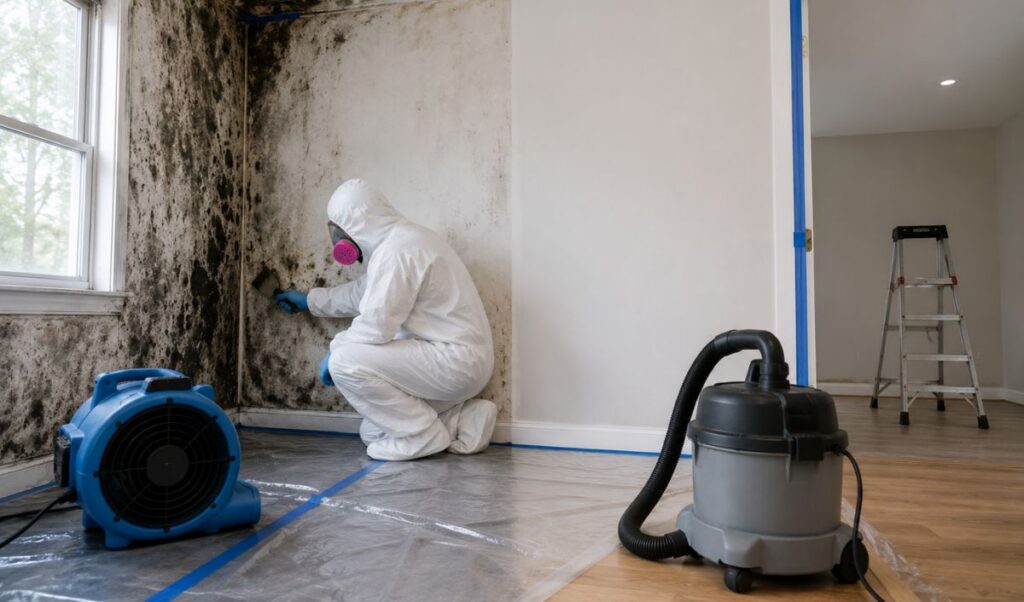
The work area is sealed with plastic barriers and put under negative air pressure. This matters more than most homeowners realize. Disturbed mold releases millions of spores, and uncontained work can spread contamination through the whole house. Containment is the clearest dividing line between professionals and improvisers.
3. Air Filtration
HEPA air scrubbers run throughout the project, capturing airborne spores down to a microscopic size. Workers wear respirators and protective gear because remediation deliberately disturbs colonies to remove them.
4. Removal of Contaminated Materials
Porous materials with significant growth, like drywall, insulation, and carpet pad, are removed and bagged inside the containment. Non-porous and semi-porous surfaces are HEPA-vacuumed, then cleaned with appropriate antimicrobial agents. This is the genuine “mold removal” step, done inside a controlled environment.
5. Drying and Moisture Correction
The source gets fixed: the leak repaired, the ventilation improved, the humidity controlled. The structure is then dried to verified moisture levels. This step is what makes the result permanent.
6. Post-Remediation Verification
Reputable firms verify their work with clearance inspection and, when warranted, independent air sampling. The standard of success is measurable: spore levels consistent with a normal indoor environment. If a company can’t explain how they’ll prove the job worked, keep looking.
When Can You DIY, and When Do You Need a Pro?
Small, surface-level mold is a homeowner’s job. The EPA’s guideline is that areas under about 10 square feet can usually be handled yourself, using detergent, water, and protective gloves and a mask.
Call a professional when any of these apply:
- The affected area exceeds roughly 10 square feet
- Mold returns after you’ve already cleaned it
- You smell mustiness, but can’t find visible growth
- Contamination touches HVAC systems or ductwork
- The mold followed a sewage backup or flooding
- Anyone in the home has asthma, allergies, or immune issues
That last one deserves emphasis. Disturbing mold without containment can make air quality worse than leaving it alone.
One more DIY warning: skip the bleach. On porous materials like drywall and wood, bleach’s water content soaks in while the chlorine stays on the surface. You can end up feeding deeper growth while bleaching the visible stain, which hides the evidence without fixing the problem.
The Bottom Line: Hire for Remediation, Not Promises
The difference between mold removal and mold remediation isn’t semantics; it’s the difference between hiding a symptom and curing the condition. The right company finds the water, contains the work, physically removes contamination, and proves the result.
If you’re dealing with mold in Utah, Utah Disaster Kleenup has handled it since 1974. Our mold removal teams follow industry remediation standards, correct the moisture source, and work directly with your insurance.
Found or suspect mold? Call UDK at (801) 553-1010 for a professional assessment.
Frequently Asked Questions
Is mold removal the same as mold remediation?

No. Mold removal describes physically eliminating mold from surfaces, and it’s one step within remediation. Mold remediation is the full professional process: finding the moisture source, containment, removal, air filtration, drying, and verification. Since removing all mold spores from a building is impossible, remediation, returning levels to normal, is the accurate and achievable standard.
Can mold be completely removed from a house?
No, and no honest company will claim otherwise. Mold spores exist naturally in all indoor and outdoor air. The realistic goal is a home where spore levels match a normal environment and where no moisture allows growth. That’s exactly what professional remediation delivers and verifies.
Why does dead mold still matter?
Because dead spores and fragments remain allergenic and irritating. Killing mold with a spray doesn’t remove the particles that trigger reactions; they stay on surfaces and in the air until physically removed. That’s why remediation emphasizes HEPA vacuuming and physical removal over simply applying chemicals.
How long does mold remediation take?
Small contained areas often take one to three days. Larger projects involving demolition, structural drying, and rebuild can take a week or more. The moisture correction is what extends timelines, and rushing it is how mold comes back. Be wary of any company quoting a few hours for significant contamination.
Does homeowners’ insurance cover mold remediation?
Sometimes. Coverage usually depends on the cause. Mold from a sudden, covered event, like a burst pipe, is often included; mold from long-term leaks or humidity is typically excluded. Many policies also cap mold payouts. Document the source quickly, because proving the cause is what determines coverage.
How do I know a mold company is legitimate?
Ask three questions. Do they follow the IICRC S520 standard? Will they identify and fix the moisture source, not just treat surfaces? How will they verify the job worked? Legitimate firms answer all three specifically. Walk away from anyone promising “100% mold removal” or skipping containment.