
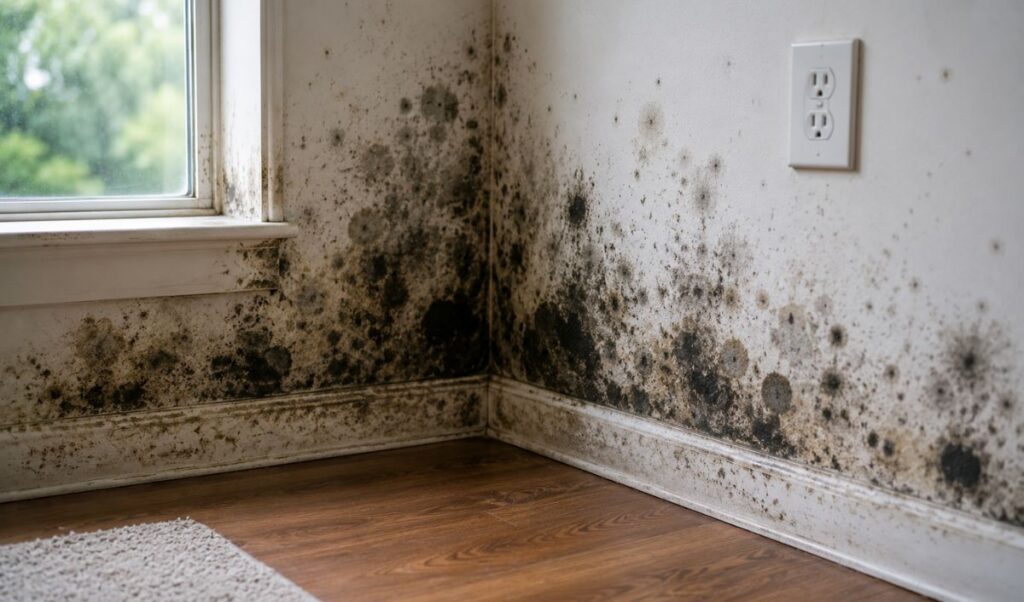
Isn’t Utah too dry for mold? That’s the question behind half the mold calls restoration companies receive, usually asked by a surprised homeowner staring at a black patch in their basement. Utah’s desert air should make mold rare. Instead, mold thrives here in specific, predictable places.
The reason is simple once you see it: mold doesn’t care about the climate outside your walls. It cares about the moisture inside them, and Utah homes create indoor moisture in ways most homeowners never connect to mold. Understanding the common causes of mold in Utah homes is what turns prevention from luck into a checklist.
Here are the seven causes behind most Utah mold problems, including a few that are uniquely ours.
Quick Answer
The most common causes of mold in Utah homes are winter window condensation, plumbing leaks, and spring snowmelt seeping into basements. Swamp coolers, unvented bathroom moisture, roof leaks, and over-humidified winter air round out the list. Despite Utah’s dry climate, each source traps indoor moisture where it can’t dry. Keep indoor humidity between 30% and 50% to keep mold from gaining a foothold.
What Are the Common Causes of Mold in Utah Homes?
Each cause below answers the same underlying question: why does mold grow in homes surrounded by desert? Because every one of these puts water where it can’t easily dry.
1. Winter Window Condensation
Utah winters create a daily physics experiment on your windows. Warm indoor air hits cold glass, and water beads up on panes, sills, and frames. Day after day, that moisture soaks window sills, drywall edges, and curtains.
By February, the south-facing bedroom window has quietly grown a colony along the frame. Older single-pane windows and bedrooms where doors stay closed are the usual victims.
2. Plumbing Leaks and Water Damage
A slow drip under a sink or inside a wall is a permanent moisture supply, and mold needs nothing more. The link between moisture and mold growth is fast: spores can establish on wet materials within 24 to 48 hours.
This is also why mold after water damage in Utah homes, which is experienced so often, traces back to a leak that was “fixed” but never professionally dried. The pipe gets repaired; the wet wall cavity gets forgotten.
3. Spring Snowmelt and Basement Seepage
Utah’s snowpack is wonderful until April. When it melts, weeks of runoff push moisture against foundations and basements, where most Utah homes have finished living space, and take the hit.
Seepage through foundation cracks, window wells, and slab joints feeds mold behind drywall and under carpet pad. If your basement smells musty every spring, snowmelt is the prime suspect.
4. Swamp Coolers
Here’s the most Utah-specific cause on the list. Evaporative coolers work by adding moisture to the air, which is exactly what mold wants.
Pads that stay wet between uses, units that don’t fully drain in the fall, and ducts that carry humid air all become growth sites. Swamp coolers can be run safely, but they require seasonal maintenance and proper winterization, which many homeowners skip.
5. Unvented Bathroom and Kitchen Moisture
Every shower releases a pint or more of water into the air, and in a tightly sealed modern home, that moisture has nowhere to go. Bathrooms without exhaust fans, or with fans nobody runs, grow mold on ceilings, grout, and window frames. Utah’s dry reputation works against us here; people assume the air will handle it, and the bathroom proves otherwise.
6. Roof Leaks and Ice Dams
Winter roof problems feed attic mold all season. Ice dams push meltwater under shingles, and small roof leaks drip onto insulation where nobody looks for months. Attic mold often announces itself only through musty upstairs rooms or frost on the sheathing. The slow leaks are the dangerous ones; they stay hidden long enough to colonize entire roof decks.
7. Over-Humidified Winter Air
Utah’s winter air is so dry that humidifiers are practically standard equipment. The trouble starts when they’re set too high. The EPA recommends keeping indoor humidity between 30% and 50%; push past 60% and condensation forms inside wall cavities and on cold surfaces. Whole-home humidifiers left at one setting all winter are a quiet, common culprit.
Mold Prevention for Utah Homes
The pattern across all seven causes is moisture without an exit. Practical mold prevention Utah homeowners can do this weekend:
- Buy a $15 hygrometer and keep indoor humidity between 30% and 50%, adjusting humidifiers seasonally.
- Run bathroom fans during showers and 20 minutes after, or crack a window when there’s no fan.
- Wipe window condensation in winter and consider upgrading the worst single-pane offenders.
- Maintain swamp coolers seasonally: fresh pads, full drainage, and proper winterization every fall.
- Grade soil away from the foundation and extend downspouts before spring melt arrives.
- Dry any water event within 24 to 48 hours, and verify drying with moisture readings rather than touch.
Control the Moisture, and the Mold Takes Care of Itself
The common causes of mold in Utah homes all reduce to the same equation: moisture plus time plus a surface to grow on. Every cause on this list is controllable once you know where to look. Fix the condensation, maintain the swamp cooler, manage the humidity, and dry water events fast, and mold never gets its 48-hour head start.
If mold has already taken hold in your home or business, Utah Disaster Kleenup has solved the source and the symptom since 1974. Our mold removal teams handle inspection through verified remediation under one roof.
Found mold or a moisture problem? Call UDK at (801) 553-1010 for an assessment.
Frequently Asked Questions
Why does mold grow in homes in a desert climate like Utah’s?

Because indoor moisture is independent of outdoor climate. Showers, cooking, humidifiers, swamp coolers, leaks, and snowmelt all create water inside the home, and tightly sealed modern construction traps it. Mold doesn’t need humidity; it needs a damp surface and 24 to 48 hours.
What humidity level prevents mold?
Keep indoor humidity between 30% and 50%. Below 30%, the air feels harsh and woodwork cracks; above 60%, condensation starts feeding mold in cool corners and wall cavities. A basic hygrometer in the basement and main living area tells you where you stand year-round.
Are swamp coolers bad for mold?
Not inherently, but they’re the most neglected moisture source in Utah homes. A maintained cooler with fresh pads and proper fall-winterization is fine. A neglected one circulates humid air through ducts all summer and sits wet all winter. If your home smells musty when the cooler runs, have the unit and ducts inspected.
Does mold come back after remediation?
Only if the moisture source survives. Professional work always pairs removal with source correction, which is why reputable mold remediation Utah companies perform moisture mapping before any cleanup. Mold that returns within months means the water problem was treated as an afterthought.
When should I call a professional instead of cleaning mold myself?
Call when the growth exceeds about 10 square feet, returns after cleaning, sits inside walls or HVAC ducts, or follows flooding. Anyone in the home with asthma or allergies lowers that threshold. Knowing the signs of mold in your home helps you assess the extent before deciding.
What does professional mold remediation include?
Full remediation covers moisture mapping, sealed containment with negative air pressure, HEPA filtration, removal of contaminated materials, drying, and verification that levels are back to normal. UDK handles the entire sequence, including moisture-source repair and rebuild, with direct insurance billing where applicable.