
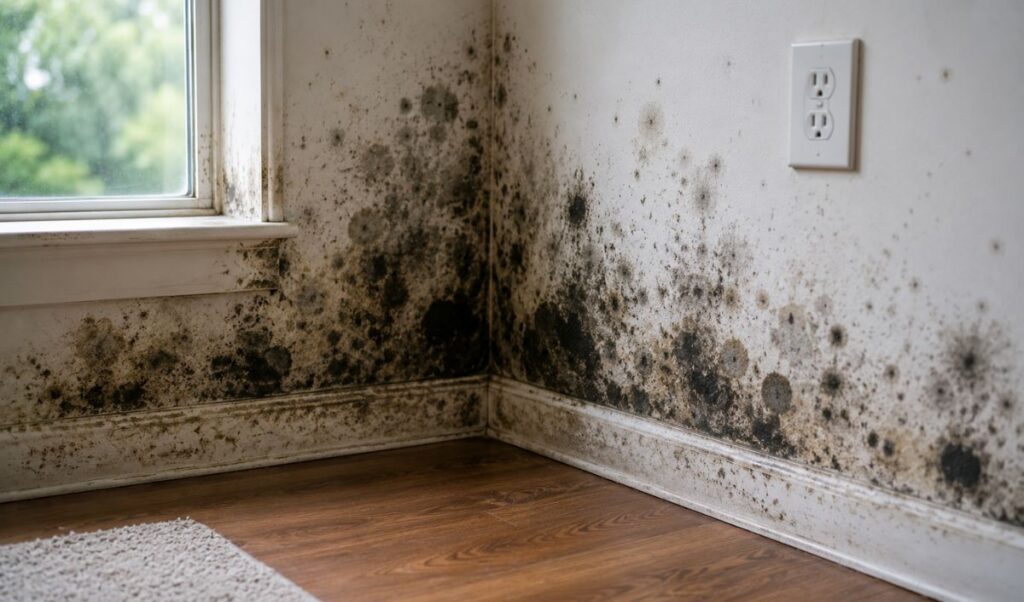
Mold has one job: stay hidden long enough to spread. It grows behind drywall, under flooring, inside HVAC ducts, and above ceiling tiles. By the time a colony shows itself on a visible wall, it has often been growing somewhere darker for months.
That hiding ability is why so many homeowners discover mold late, after the musty smell becomes permanent or the allergies become year-round. The signs of mold in your home are usually there early. Most people just don’t know how to read them.
Here are the seven signs that matter, including the ones that don’t look like mold at all, and exactly what to do if you spot them.
Quick Answer
The most common signs of mold in your home are a persistent musty odor, spots that look like dirt or soot, and allergy symptoms that improve when you leave the house. Other warnings include past water damage, chronic condensation or humidity, peeling or bulging surfaces, and dark staining on grout, sills, or vents. If you find mold, don’t scrub or spray it. Fix the moisture source, and call a professional for anything larger than about 10 square feet.
What Are the Signs of Mold in Your Home?
Some of these signs are obvious. The most important ones are the ones that don’t look like mold at all.
1. A Musty Smell That Won’t Go Away
Mold announces itself by smell before sight. That earthy, damp odor comes from gases mold releases as it grows (microbial volatile organic compounds, or MVOCs). If a room smells musty after cleaning and airing out, trust your nose. The growth is likely inside a wall, under flooring, or in the HVAC system.
2. Spots That Look Like Dirt, Soot, or Stains
Not all mold looks like the fuzzy patches in photos. Early growth often resembles scattered dirt, soot specks, or a faint shadow on walls, ceilings, or grout. Colors range from black and green to white, orange, and pink. A quick test: dab the spot with bleach on a swab. Dirt stays dark; mold typically lightens within a minute or two.
3. Allergy Symptoms That Improve When You Leave Home
Your body often detects mold before your eyes do. According to the CDC, mold exposure can cause a stuffy nose, wheezing, coughing, and itchy eyes, with stronger reactions in people with asthma or mold allergies. The telltale pattern is location-based: symptoms that flare at home, especially in certain rooms or at night, and ease at work or on vacation. Year-round “colds” and morning congestion deserve the same suspicion.
4. Current or Past Water Damage
Mold needs moisture, and water damage is its delivery system. Any history of leaks, flooding, or roof problems puts mold on the suspect list, even if the area looks dry now. If the drying after a past leak wasn’t professionally verified, assume the wall cavities stayed wet longer than the surfaces did.
5. Chronic Condensation or High Humidity
Watch your windows on cold mornings. Persistent condensation on glass, pipes, or toilet tanks means indoor humidity is high enough to feed mold without a single leak. The EPA recommends keeping indoor humidity between 30% and 50% to prevent growth. Basements, bathrooms without fans, and rooms with poor airflow are the usual trouble zones. A $15 hygrometer tells you where you stand.
6. Peeling Paint, Bulging Walls, or Warped Surfaces
When moisture builds inside walls, surfaces show it before mold becomes visible. Paint peels or bubbles, wallpaper lifts, drywall bulges, and wood trim warps. We cover these flags in our guide to the signs of water damage in your home. Where there’s trapped moisture, mold is rarely far behind.
7. Dark Staining on Grout, Window Sills, or Vents
Blackened grout lines, grimy window tracks, and dark rings around HVAC vents are often dismissed as normal household grime. Frequently, they’re active mold colonies in the home’s dampest microclimates. Vent staining deserves particular attention. If mold is growing in ductwork, the HVAC system distributes spores to every room each time it runs.
What to Do If You Find Mold
What you do in the first hour matters more than most homeowners realize. The instinct to scrub immediately is usually the wrong one.
First, don’t disturb it. Dry scrubbing or brushing launches thousands of spores into the air, spreading the problem and worsening exposure. Skip the bleach too; on porous materials like drywall and wood, it whitens the stain while the moisture soaks deeper.
Then work through this sequence:
- Find the moisture. Mold is a symptom; water is the cause. Look for leaks, condensation, or humidity feeding the growth.
- Fix what you safely can. Repair the drip, run the bathroom fan, add a dehumidifier, improve airflow.
- Size the problem. Small surface patches under about 10 square feet on non-porous surfaces are typically a DIY job with detergent, water, gloves, and a mask.
- Call a professional for anything bigger, anything recurring, anything inside walls or HVAC, or any mold following flooding or sewage.
- Document everything with photos and dates in case an insurance claim becomes relevant.
Professional handling matters because proper work uses containment, negative air pressure, and HEPA filtration to remove mold without spreading it. We’ve broken down what that process involves, and what separates real work from spray-and-pray, in our guide to mold removal vs. mold remediation.
Trust the Signs, Then Act on the Source
The signs of mold in your home rarely shout. They show up as a smell you keep explaining away, allergies that follow you room to room, and stains that keep returning. Read them early and the fix is small. Ignore them and the fix involves demolition.
If you’ve spotted these warnings in your Utah home or business, Utah Disaster Kleenup can find the source and solve it. Since 1974, our mold removal teams have used moisture mapping, containment, and verified remediation to fix mold permanently.
Smell it or see it? Call UDK at (801) 553-1010 for a professional mold assessment.
Frequently Asked Questions
What does mold smell like?

Musty, earthy, and damp, like wet cardboard or a forest floor. The smell comes from gases mold emits while actively growing, so a strong odor usually means a live colony. If the smell strengthens when the HVAC runs, check the system and ducts.
Can mold make you sick?
It can affect many people, especially those with allergies, asthma, or weakened immune systems. Common reactions include congestion, coughing, wheezing, itchy eyes, and skin irritation. For asthmatics, exposure can trigger attacks. Reactions vary widely between people, so one family member can feel fine while another struggles in the same house.
Is black mold more dangerous than other molds?
“Black mold” usually refers to Stachybotrys, which has a fearsome reputation. The practical answer: color is a poor danger gauge, and testing is the only way to identify species. Health agencies recommend treating all indoor mold the same way: remove it and fix the moisture, regardless of color.
When should I call for professional mold removal services?
Call when the mold covers more than about 10 square feet, keeps returning after cleaning, or sits inside walls, ceilings, or HVAC systems. Call too if you smell mold but can’t find it, or if anyone at home has asthma, allergies, or immune issues. After flooding or sewage backup, skip DIY entirely. When in doubt, an inspection is cheap compared to guessing wrong.
What happens during a professional mold inspection?
Technicians trace moisture, not just mold. Expect moisture meters and thermal imaging to map wet areas behind walls and under floors. The inspector assesses how far growth extends and identifies the water source feeding it. You should leave with a clear scope of work and an estimate. At UDK, inspections also document everything needed if an insurance claim applies.
What does professional mold removal include?
Proper service covers the full remediation sequence: containment with negative air pressure, HEPA filtration, removal of contaminated materials, antimicrobial cleaning, drying, and correction of moisture sources. The job ends with verification that mold levels are back to normal. UDK crews handle all of it, including repairs and rebuild, and bill your insurance directly.
Can mold grow without a leak?
Yes. Humidity above roughly 60%, chronic condensation, and poor ventilation can sustain mold with no plumbing failure at all. That’s why bathrooms without exhaust fans and closed-up basements grow mold in homes with perfect plumbing. Keeping humidity in the 30-50% range removes that fuel.