
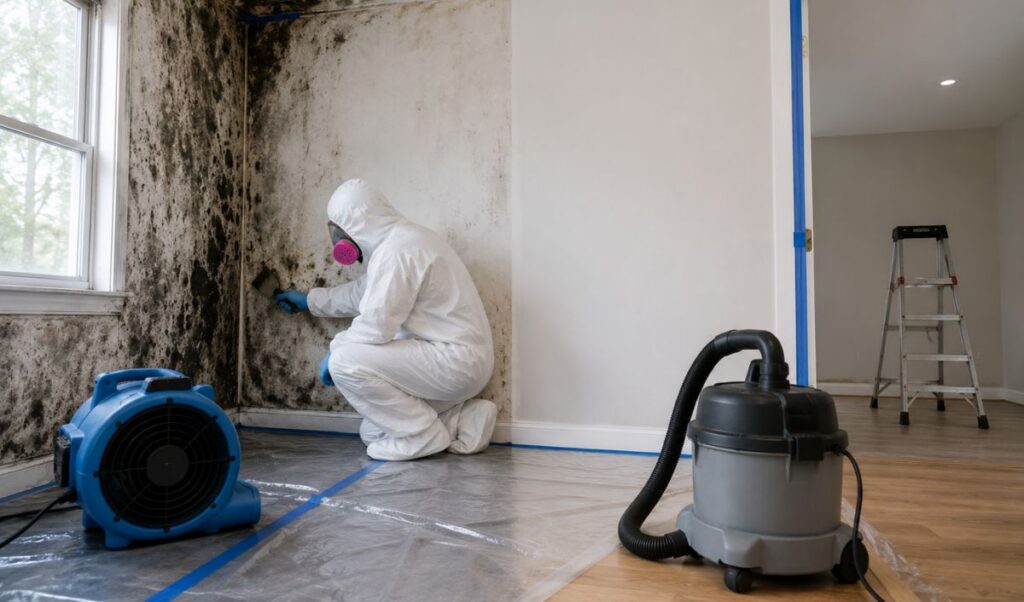
“How long will this take?” is usually the second question homeowners ask about mold, right after “how bad is it?” It deserves a straight answer. Not the “every job is different” dodge that most businesses offer.
So here’s the straight answer: how long does mold remediation take? Most residential projects run one to seven days, with small jobs finishing in a day or two and larger ones stretching to two weeks or more.
The honest part is what controls that range, because it’s rarely what homeowners expect. Removing mold is fast. Drying the structure and proving the job worked are what set the schedule.
Here’s the full mold remediation timeline, what speeds it up, what slows it down, and the one quote that should make you hang up the phone.
Quick Answer
How long does mold remediation take? For most homes, 1 to 7 days. Small, contained areas under 10 square feet usually take 1 to 3 days. Moderate contamination covering a room takes 3 to 7 days to resolve. Extensive mold involving multiple rooms, wall cavities, or HVAC systems can take 1 to 2 weeks or longer. Structural drying and clearance verification, not the mold removal itself, are what extend timelines. Rebuild work is scheduled separately.
Mold Remediation Timeline by Project Size
Project size is the biggest timeline driver. Here’s how the ranges break down in practice:
- Small (under 10 square feet): 1-3 days. A patch on a bathroom wall or windowsill. One containment, limited material removal, quick dry-down.
- Moderate (10-100 square feet): 3-7 days. Mold across a wall, behind a vanity, or under flooring. Expect demolition, deeper drying, and more thorough cleaning.
- Extensive (over 100 square feet or multiple areas): 1-2+ weeks. Whole rooms, wall cavities, crawl spaces, or HVAC involvement. Often follows flooding or a long-hidden leak.
Two clarifications make these numbers honest. First, remediation and rebuild are separate phases. The timelines above cover making the space clean, dry, and verified; reinstalling drywall, flooring, and paint adds days to weeks, depending on the scope.
Second, some companies answer “how long does mold removal take?” with “a few hours.” For significant contamination, that quote usually means spray and leave, the shortcut that separates mold removal from real mold remediation.
What Are the Mold Remediation Steps and How Long Does Each Take?
A professional job follows a defined sequence, with standards set by the IICRC S520 Standard for Professional Mold Remediation. Here’s each step with realistic durations.
1. Inspection and Assessment (a few hours to 1 day)
Technicians map moisture with meters and thermal imaging, trace the water source, and scope the contamination. Insurance documentation starts here too.
2. Containment and Setup (a few hours)
The work area gets sealed with barriers and placed under negative air pressure. HEPA air scrubbers start running. Fast to set up, and non-negotiable.
3. Material Removal and Cleaning (1-3 days)
Contaminated porous materials like drywall and insulation are removed and bagged. Remaining surfaces are HEPA-vacuumed and treated with antimicrobials. This is the step people picture as “remediation,” and it’s often the quickest major phase.
4. Structural Drying (1-5 days)
Here’s the part nobody warns you about: drying sets the schedule. Dehumidifiers and air movers run continuously, but wood, concrete, and framing release moisture at their own pace. You can’t rush biology or physics. Technicians take daily moisture readings, and the equipment stays until the numbers, not the calendar, say dry. Skipping this step is how mold returns within weeks.
5. Clearance and Verification (1-2 days)
The final step is proving it worked. Visual inspection, moisture verification, and, when warranted, third-party air sampling with lab results that take a day or two. Reputable companies don’t remove containment until the space passes.
What Factors Affect How Long Mold Remediation Takes?
Two identical-looking mold patches can carry very different timelines. These are the variables that move the schedule:
- Location of growth. Surface mold is quick; mold inside wall cavities, crawl spaces, or ductwork requires access work that adds days.
- The moisture source. A dripping fitting is fixed in an hour. A foundation seepage problem or roof issue can hold the whole timeline hostage.
- Material types. Non-porous surfaces clean fast. Porous materials need removal, and semi-porous wood needs longer drying and treatment.
- How long has the mold grown? A two-week-old patch sits on the surface. A two-year colony has penetrated deep into the materials.
- Utah’s climate quirks. Our dry air helps drying, but winter remediation in cold basements and crawl spaces slows evaporation. The mold remediation process Utah homes go through in January often needs supplemental heat.
- Insurance approvals. Emergency mitigation starts immediately, but rebuild phases sometimes wait on adjuster’s sign-off.
The Honest Timeline Is the Trustworthy One
So, how long does mold remediation take? Plan for one to three days on small jobs and up to a week for a contaminated room. Expect two weeks or more when walls, floors, or HVAC are involved. Be suspicious of anyone quoting hours for serious mold, and equally suspicious of anyone who can’t explain what each day is for.
If you’re facing mold in Utah, Utah Disaster Kleenup will give you a real timeline upfront. Since 1974, our mold removal teams have handled remediation through rebuild under one roof, with direct insurance billing.
Need a timeline for your situation? Call UDK at (801) 553-1010 for an assessment.
Frequently Asked Questions
Can I stay home during mold remediation?

Usually, yes. Containment and negative air pressure are designed to isolate the work zone from the rest of the house. You’ll need to stay out of the contained area and expect equipment noise around the clock. For whole-home contamination or residents with serious respiratory conditions, temporary relocation may be recommended.
How long does mold remediation take if the mold is removed in hours?
Because removal is only one step of five. Drying the structure to verified moisture levels takes one to five days, and clearance verification adds more. A company that hands your space back wet has guaranteed the mold’s return. The waiting is the work.
How long until mold comes back after remediation?
If the moisture source was truly fixed, it shouldn’t come back at all. Recurrence within weeks or months means the water problem was never solved, only the symptom. That’s why proper remediation always includes source correction, and why you should ask every company how they’ll address the moisture, not just the mold.
How long after remediation can the rebuild start?
As soon as the space passes clearance, typically the same week. Rebuild duration depends on scope: patching drywall takes a day or two, while replacing flooring and full walls can take one to three weeks. Companies that handle both phases, like UDK, compress this timeline by scheduling a rebuild as remediation finishes.
Does insurance affect the remediation timeline?
Emergency mitigation can begin immediately; insurers expect you to prevent further damage. Delays usually appear at the rebuild phase, where adjusters approve scope and pricing. Choosing professional mold remediation Utah insurers already know, with documentation done their way, keeps approvals moving.
How quickly should remediation start after finding mold?
Immediately. The answer to how long does mold remediation take depends partly on how early you catch it. Active mold keeps spreading while moisture is present, and growth that doubles in area can double the timeline and cost. Knowing the signs you have mold in your home helps you catch it while the job is still a small one.