
Planning to scrape that textured ceiling? Pull up some old flooring? Knock out a wall? Before any of that, one question is worth five minutes of your time: could the material you’re about to disturb contain asbestos?
It’s a fair question for almost any older home or commercial building, and the answer starts with a fact worth knowing: the EPA confirms you cannot tell whether a material contains asbestos just by looking at it.
What you can do is read the probability. Asbestos was used in predictable products and predictable years, which means your building’s age, materials, and their condition tell you a lot. The signs your building contains asbestos are less about what you see and more about what it was built with.
Here’s how to read your building like an inspector would, and the one rule that protects you: test before you touch.
Quick Answer
The strongest signs your building contains asbestos are its age and its materials. Buildings constructed before 1980 carry the highest risk. Suspect materials include 9×9-inch floor tiles, popcorn ceilings, wrapped pipe insulation, vermiculite attic insulation, and cement siding or roofing. Damaged, crumbling versions of these materials are the most dangerous. No visual check is conclusive; only laboratory testing confirms asbestos, so never cut, sand, or demolish suspect materials before an inspection.
What Are the Signs Your Building Contains Asbestos?
Think of these as probability multipliers. One alone means “maybe.” Several together mean “test before you touch anything.”
1. The Building Was Constructed Before 1980
Age is the single most reliable indicator. Asbestos was used heavily in U.S. construction from the 1940s through the 1970s, appearing in insulation, flooring, ceilings, and dozens of other products. Regulations tightened through the 1980s, but leftover stock was legally installed for years afterward. A practical rule: pre-1980 buildings should be treated as containing asbestos somewhere until testing says otherwise. Much of Utah’s older housing along the Wasatch Front falls squarely in this window.
2. 9×9-Inch Floor Tiles or Black Mastic
Flip a tape measure onto old vinyl flooring. Tiles in 9×9-inch format are a classic asbestos-era product, and 12×12 versions from the same decades can contain it too. The black adhesive beneath them, called mastic, frequently contains asbestos even when the tiles don’t. Tiles hiding under newer flooring layers count; renovations often buried them rather than removing them.
3. Popcorn or Textured Ceilings
Sprayed acoustic “popcorn” ceilings installed before the mid-1980s commonly contain asbestos. So do some textured wall finishes from the same era. These surfaces shed material when scraped, drilled, or even scrubbed, which is exactly how fibers go airborne. If your ceiling predates 1990 and hasn’t been tested, don’t scrape it for a remodel.
4. Wrapped or Corrugated Pipe and Duct Insulation
Look at the pipes in your basement, boiler room, or crawl space. White or gray insulation wrapped like a cast, or corrugated cardboard-style coverings on elbows and joints, are hallmark asbestos-containing materials. Old furnace and duct tape-wrap belongs on the same list. This insulation becomes more dangerous as it ages and frays.
5. Vermiculite Attic Insulation
Vermiculite looks like small, pebble-like, gray-brown or silvery granules poured between attic joists. Most of the U.S. supply came from a mine in Libby, Montana, that was contaminated with asbestos. If your attic has loose, poured granular insulation, stay out of the attic and don’t disturb it until it’s tested.
6. Cement Siding, Roofing, or Flue Pipes
Asbestos-cement products, often called transite, appear as rigid corrugated panels, shingle siding, roof tiles, and old flue pipes. They’re durable and relatively safe while intact. Cutting, drilling, or breaking them releases fibers, which is why they become a problem during renovations and demolitions.
7. Damaged, Crumbling, or Friable Materials
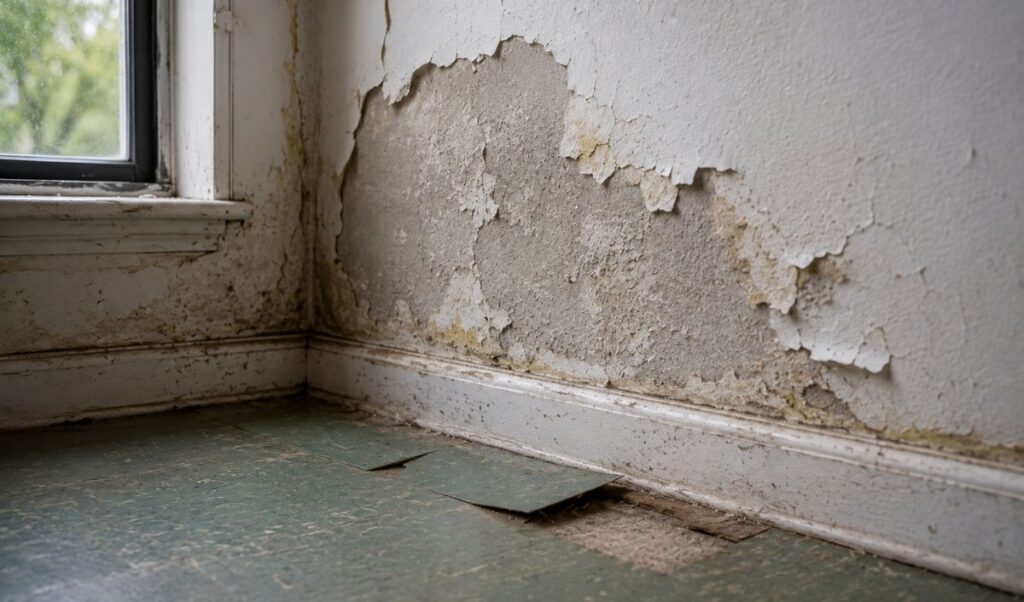
Condition is the sign that changes everything. Intact asbestos materials are generally a managed risk; damaged ones are an active hazard. “Friable” means the material crumbles under hand pressure, releasing fibers into the air.
Water damage, age, and renovation work all push materials toward friability. The CDC’s NIOSH notes there is no safe level of asbestos exposure, and inhaled fibers can cause asbestosis, lung cancer, and mesothelioma decades later.
What to Do If You Suspect Asbestos
The right response is calm and procedural, not panicked. Asbestos hurts people when it’s disturbed, so your job is to prevent disturbance.
- Leave it alone. Don’t touch, cut, sand, drill, or scrape suspect materials. Keep kids and pets away from damaged areas.
- Don’t DIY a sample. Cutting a piece for testing releases the very fibers you’re worried about. Sampling is a trained-technician task with wetting agents and protective gear.
- Schedule a professional asbestos inspection. Utah requires certified inspectors, and an inspection maps every suspect material with lab confirmation. For any asbestos testing Utah property owners arrange, expect samples to go to an accredited laboratory.
- Know the renovation rule. Utah’s Division of Air Quality requires an asbestos survey before demolition and many renovation projects. Skipping it risks fines and, worse, contaminating your own building.
- Abate only through licensed professionals. If results come back positive, certified abatement uses containment, negative air pressure, and regulated disposal. This is one home project with no responsible DIY version.
Read the Signs, Then Test Before You Touch
The signs your building contains asbestos are really a checklist of age, materials, and condition. A pre-1980 building with 9×9 tiles, wrapped pipes, or a popcorn ceiling deserves testing before any renovation, and damaged materials deserve it immediately. The fibers you can’t see are the reason the rule is simple: when in doubt, don’t disturb.
If your Utah home or business shows these signs, Utah Disaster Kleenup’s asbestos removal team has handled safe, compliant abatement since 1974.
Suspect asbestos? Call UDK at (801) 515-3601 before you cut, scrape, or demo.
Frequently Asked Questions
Can I tell if something is asbestos just by looking at it?

No, and anyone who claims they can is guessing. Every honest answer to how to identify asbestos ends at the same place: a laboratory. Fibers are microscopic and were blended into materials that look identical to asbestos-free versions. Visual signs only establish probability based on age and product type; lab analysis of a professionally collected sample is the only confirmation.
Is asbestos dangerous if I don’t touch it?
Intact, undamaged asbestos materials generally release few or no fibers and are often safer left managed in place. The danger comes from disturbance: cutting, sanding, demolition, or deterioration. That’s why the rule is identify and assess first. Sometimes the right professional answer is encapsulation rather than removal.
How much does asbestos testing cost?
A professional asbestos inspection Utah homeowners typically order runs a few hundred dollars, depending on building size and sample count. Individual lab samples often cost $25 to $75 each. Against the health stakes and the cost of accidental contamination, testing is the cheapest step in the entire process.
What happens during professional asbestos removal?
Licensed crews seal the work area with containment barriers and negative air pressure, wear respirators, and wet materials to suppress fibers. Waste is double-bagged and taken to approved disposal sites, with air clearance testing afterward. For asbestos removal Utah regulations require notification to the state before work begins, which your abatement contractor handles.
Does UDK handle both testing coordination and removal?
Yes. UDK’s environmental team manages the full sequence: inspection coordination, lab-confirmed identification of asbestos containing materials, licensed abatement with containment, and final clearance. One company through the whole process means nothing falls between contractors, and documentation stays consistent for compliance.