
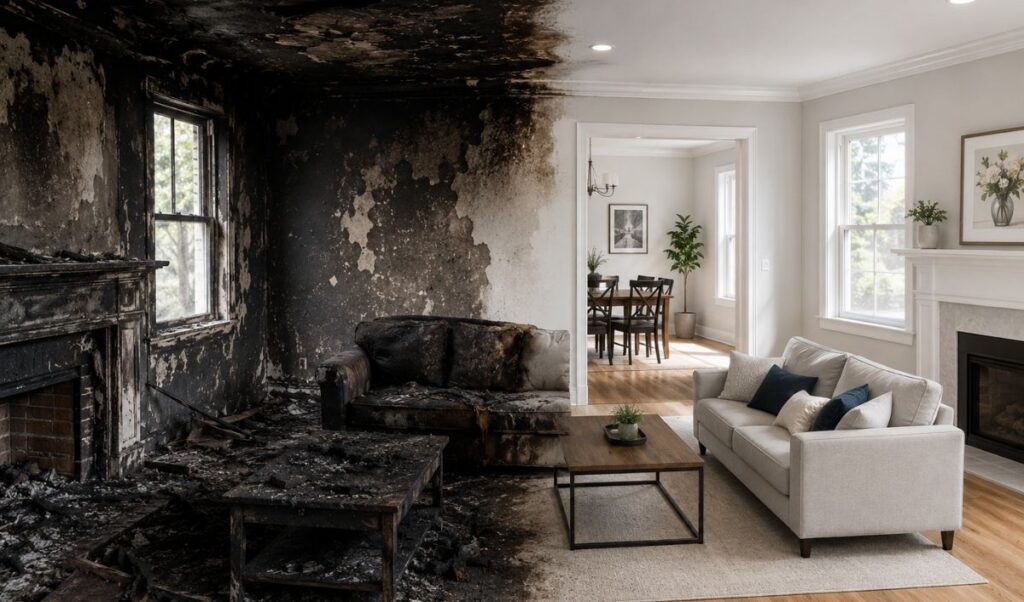
What makes smoke odor the most stubborn thing a fire leaves behind? Soot wipes away, stains get painted over, and damaged materials get replaced. The smoke smell after fire damage, though, fades for an afternoon and then walks right back in, no matter how many windows you open.
That persistence has a cause, and the cause has a fix. It comes down to what smoke actually is and where it hides. Once you understand that, removal stops being a guessing game and becomes a sequence.
Here’s how to remove smoke odor after a fire, the way restoration pros do it, including which steps are safe to DIY and which ones aren’t.
Quick Answer
Here’s how to remove smoke odor after a fire. Ventilate and assess the soot type, remove soot from all surfaces before deodorizing, and run HEPA air scrubbers with activated carbon.
Also, deep-clean hard surfaces and launder soft goods; clean the HVAC system and ducts. You should also neutralize embedded odors with thermal fogging, ozone, or hydroxyl treatment, and seal any surfaces still holding odor with blocking primer. Cleaning removes the particles; deodorizing equipment neutralizes what cleaning can’t reach.
Why Smoke Odor Won’t Just Air Out
Smoke behaves like a gas but settles like a solid. During a fire, hot smoke gets driven deep into porous materials: drywall, insulation, carpet pad, upholstery, wood framing, and the oils in painted surfaces. As the house cools, those particles bond in place.
That’s why candles, sprays, and open windows disappoint. They treat the air, but the air isn’t the source; the building is. Every time the temperature and humidity rise, embedded particles release odor again, which is why the smell “comes back” on warm days.
Worse, one kitchen fire quirk: protein fires from burnt food leave a nearly invisible residue with one of the most stubborn odors in restoration. A house can look clean and still smell like the fire happened yesterday.
Understanding that changes how to remove smoke odor after a fire from guesswork into a sequence: remove the source first, neutralize what’s left second.
How to Remove Smoke Odor After a Fire: The 7 Pro Steps
The order of these steps matters as much as the steps themselves. Each one prepares the next: source removal makes air scrubbing effective, cleaning makes deodorization stick, and sealing only works on surfaces already treated. Skip ahead and you’ll repeat work.
Step 1: Assess the Damage and Ventilate
Professionals start by identifying what burned, because soot type dictates the cleaning chemistry. Synthetic materials leave smeary residue, wood leaves dry soot, and protein fires leave that invisible film.
While assessment happens, controlled ventilation with fans exchanging indoor air begins flushing loose particles. Safe to DIY: opening up and airing out. Just know it’s step one, not the solution.
Step 2: Remove Soot Before You Deodorize
Here’s the sequence mistake that wastes the most money: deodorizing before soot removal. Soot is the odor source, and it’s acidic enough to permanently stain metals, grout, and finishes within days.
Pros: dry-vacuum soot with HEPA equipment first, then chemically clean surfaces. Wiping with a wet rag too early smears soot deeper into surfaces, so when in doubt, vacuum before you wipe.
Step 3: Scrub the Air with HEPA and Carbon Filtration
If you want to get rid of the smoke smell fast, this is where momentum starts. Air scrubbers pull room air through HEPA filters and activated carbon that adsorbs odor molecules.
Running continuously for days, they strip the airborne load while surface cleaning continues. Household purifiers help in small rooms, but they’re a garden hose next to a fire hose.
Step 4: Deep Clean Every Surface, Including the Ones You Forget
Smoke film settles on everything: walls, ceilings, inside cabinets, on top of door frames, and behind appliances. Hard surfaces get degreasing cleaners; washable fabrics get laundered with odor-neutralizing additives, often multiple times.
Carpets and upholstery need hot water extraction, and heavily saturated carpet pad usually gets replaced. The ceiling is the most commonly skipped surface, and it’s usually the dirtiest.
Step 5: Clean the HVAC System
Your furnace and ducts inhaled smoke during the fire, and they’ll exhale it for months if untouched. Duct cleaning, coil cleaning, and fresh filters break the recontamination loop. Skipping this step is the most common reason the smoke smell after fire cleanup returns weeks later, every time the system kicks on.
Step 6: Neutralize Embedded Odor with Professional Equipment
This is where professional smoke odor removal separates from DIY. To eliminate smoke odor that’s embedded in materials, three technologies reach where cleaning can’t:
- Thermal fogging recreates smoke’s behavior, driving a deodorizing fog into the same crevices the smoke penetrated.
- Hydroxyl generators neutralize odor molecules safely while the home stays occupied, working over several days.
- Ozone treatment for smoke odor is fast and powerful, but it requires an empty, sealed building. The EPA cautions that ozone is a lung irritant, which is why professionals run it only in unoccupied spaces and air out thoroughly before re-entry.
The right choice depends on severity, occupancy, and materials, which is why pros often combine methods.
Step 7: Seal What Can’t Be Extracted
Some surfaces hold odor that no treatment fully extracts: charred framing, smoke-saturated subfloor, and certain drywall. The professional finish is an odor-blocking shellac or oil-based primer that locks remaining molecules in permanently, followed by fresh paint. Sealing is the last step, never the first; sealing over soot just delays the problem.
The Smell Is Evidence, Not a Sentence
Persistent smoke odor just means particles are still present somewhere: surfaces, fabrics, ducts, or deep in porous materials. That’s the whole secret of how to remove smoke odor after a fire: source removal, then air, then neutralization, then sealing. Follow the sequence and the odor genuinely leaves. Skip steps and it keeps returning to remind you.
For smoke odor removal Utah homes and businesses can trust, Utah Disaster Kleenup has restored fire-damaged properties since 1974. Our fire damage restoration teams handle everything from soot cleanup through deodorization and rebuild, with direct insurance billing.
Smoke smell that won’t quit? Call UDK at (801) 515-3601, any hour.
Frequently Asked Questions
Will the smell eventually go away on its own?

Mostly, no. Removing smoke smell from a minor incident can take weeks of aggressive airing, and that’s the easy case. Odor from an actual structure fire is embedded in porous materials and returns whenever heat and humidity rise. Time hides it on cool days; it doesn’t remove it.
Can I remove the smoke odor myself?
You can handle light cases: ventilation, washing fabrics, scrubbing hard surfaces, and replacing HVAC filters. What you can’t replicate is industrial HEPA scrubbing, thermal fogging, hydroxyl treatment, and safe ozone use. A practical rule: if the smell survives one full weekend of serious cleaning, the odor is embedded beyond DIY reach.
Is ozone treatment for smoke odor safe?
In professional hands, yes, because the protocol does the protecting. The building must be empty of people, pets, and plants, sealed during treatment, and ventilated before re-entry. Never run a consumer ozone generator in an occupied home. Hydroxyl generators are the occupied-home alternative, trading speed for safety.
How long does professional smoke odor removal take?
Light smoke damage often clears in 2 to 4 days. Significant fires involving cleaning, HVAC work, and fogging or ozone typically take one to two weeks. Severe cases needing sealing and repainting run longer. Timeline follows severity and how quickly treatment starts, since soot keeps bonding as it sits.
Does insurance cover smoke odor removal?
Usually, yes. Smoke and odor damage is part of fire damage under standard homeowners policies, even when flames never touched the affected rooms. Document everything before cleaning starts, and use a restoration company that bills insurance directly. At UDK, smoke odor work is documented within the broader fire claim, which keeps approvals smooth.
What does fire damage restoration include beyond odor removal?
Full fire damage restoration Utah properties receive covers board-up, structural assessment, soot and water cleanup (firefighting water causes its own damage), content cleaning, odor neutralization, and rebuild. Odor removal is one phase of a sequence, which is why companies handling the whole chain get better results than odor-only treatments.