
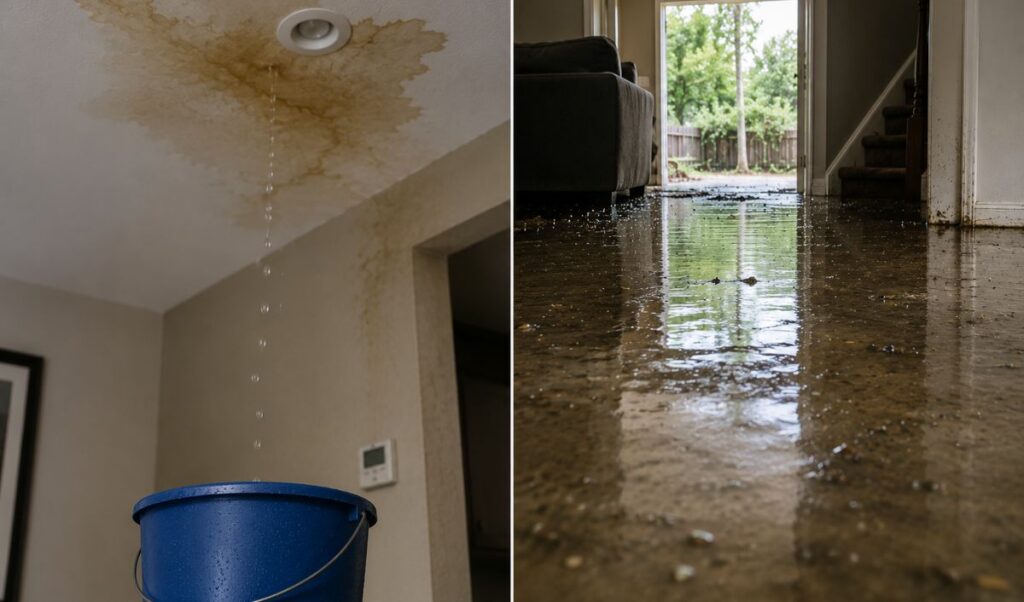
If water has ever crept across your floor, your first thought probably wasn’t about terminology. But “water damage” and “flood damage” carry very different meanings, shaping how dangerous the water is, who pays to fix it, and what the cleanup involves. In plain English, they sound identical. To your insurance company, they’re worlds apart.
Understanding the difference between water damage and flood damage before disaster strikes can save you thousands of dollars and a lot of stress. Here’s what separates the two on three levels that matter: what each physically is, what it means for insurance, and which team you call.
Quick Answer
The core difference comes down to the source of the water. Water damage comes from inside your home, like a burst pipe, an overflowing appliance, or a roof leak, and is usually covered by standard homeowners’ insurance.
Flood damage comes from outside, when water on normally dry ground rises and enters your home, and is only covered by separate flood insurance. The source also affects how contaminated the water is and how much can be saved, though the same restoration company can handle either cleanup.
What Is Water Damage?
Water damage is a broad category. It refers to any harm caused by water intruding where it shouldn’t, and the source is typically inside or attached to your home. Common causes include:
- Burst or frozen pipes
- A failed or leaking water heater
- An overflowing washing machine or dishwasher
- A backed-up drain or sink
- Rain getting in through a damaged roof
The defining trait is that the water originates from your home’s own systems, not from rising water outside. This matters enormously because sudden, accidental water damage of this kind is exactly what standard homeowners insurance is designed to cover.
Utah sees a lot of this in winter. When temperatures plunge, water in pipes freezes, expands, and splits the pipe, releasing gallons into walls and floors. A single burst pipe can saturate drywall and flooring in minutes. Our team at Utah Disaster Kleenup has handled that exact scenario across the state since 1974.
What Is Flood Damage?
Flood damage is a much narrower term, defined largely by FEMA and the insurance industry. A flood is an overflow of water onto land that is normally dry. The official National Flood Insurance Program definition requires it to affect at least two acres or two or more properties.
The key is that the water comes from outside and from the ground up. Common causes include:
- Overflowing rivers, streams, or lakes
- Heavy rainfall that pools and rises across an area
- Flash floods and storm surge
- Rapid snowmelt runoff
- Groundwater seeping up through a foundation
In Utah, rapid spring snowmelt and sudden summer thunderstorms are frequent culprits.
Here’s the catch that surprises most homeowners: standard homeowners insurance does not cover flood damage at all. Covering a true flood requires a separate flood insurance policy, through the NFIP or a private insurer.
Water Damage vs. Flood Damage: Side by Side
The clearest way to settle water damage vs flood damage is to line the two up directly.
|
Factor |
Water Damage |
Flood Damage |
|
Source of water |
Inside the home (pipes, appliances, roof) |
Outside, rising onto normally dry land |
|
Typical cause |
Burst pipe, leak, appliance failure |
Overflowing river, heavy rain, snowmelt, storm surge |
|
Direction |
Often top-down or from within walls |
Ground-up, entering from outside |
|
Usually covered by |
Standard homeowners insurance |
Separate flood insurance only |
|
Scope |
Affects one home |
Often affects an area, multiple properties |
The simplest test: ask where the water came from. If it came from your home’s plumbing, appliances, or roof, it’s water damage. If it rose up off the ground from outside and came in, it’s flood damage.
The Difference You Can’t See: Water Contamination
The two also differ in something you can’t always see but should care about: how clean the water is. Restoration pros sort water into three categories, and the source usually decides which you’re facing.
Water Damage: Often Clean, If You Act Fast
Internal water damage often starts as Category 1, or “clean water,” from a supply line or appliance hose. Caught quickly, much of what it touches can be dried and saved. Left sitting, it degrades into Category 2 “gray water,” picking up contaminants from soaps, dirt, or standing time.
Flood Damage: Almost Always Contaminated
Flood water is almost always Category 3, the worst kind, often called “black water.” Having traveled across streets, soil, and sewer systems, it carries bacteria, chemicals, and sewage, making it a genuine health hazard. It also means porous materials like carpet, padding, and soaked drywall usually have to be discarded rather than dried, since they can’t be safely sanitized.
It’s the practical reason the same inch of water means a quick dry-out in one home and a gut-and-rebuild in another. The category, not just the depth, drives the work.
What to Do When Either One Strikes
The first hours matter most, since the longer water sits, the more it spreads and the higher the mold risk within 24 to 48 hours.
Do This First
Shut off the water source if it’s an internal leak, and stay clear of standing water near electrical outlets. With contaminated flood water, avoid contact until professionals arrive. Document everything with photos and video before cleanup, since your claim depends on that evidence.
What Not to Do
Don’t wait it out or try to dry it yourself with household fans. Water hides behind walls and under floors, and surfaces feel dry while moisture lingers inside, feeding mold. Whether you need fast Water Damage Restoration Utah crews for a burst pipe or Flood Damage Restoration Utah specialists after rising water, the right response always includes moisture mapping to confirm the home is truly dry.
Frequently Asked Questions
Is a burst pipe water damage or flood damage?

A burst pipe is water damage, because the water originates inside your home rather than rising from outside. That distinction matters: standard homeowners insurance typically covers sudden pipe bursts, while flood policies do not. The same logic applies to appliance and roof leaks.
Does homeowners insurance cover flood damage?
No. Standard homeowners insurance does not cover flood damage from external rising water, which surprises many homeowners after the fact. Flooding requires a separate policy through the NFIP or a private insurer. Your homeowners coverage handles internal water damage but draws a hard line at true floods.
Do I need flood insurance if I’m not in a flood zone?
It’s worth serious thought. About one in five flood claims comes from outside high-risk zones, so a low-risk designation isn’t a guarantee. In areas prone to snowmelt or sudden storms, like much of Utah, a policy’s modest cost can prevent a devastating uncovered loss.
How fast should I call for help after water enters my home?
As fast as possible, ideally within the first few hours. Water spreads into flooring and wall cavities quickly, and mold can begin growing within 24 to 48 hours. The sooner extraction and drying begin, the less damage you face and the lower your overall cost. Reputable restoration companies, including our team, answer 24/7.
Can the same company handle both water and flood damage cleanup?
Yes. While insurance treats them differently, the physical cleanup, extraction, drying, sanitizing, mold prevention, and rebuilding follow similar professional steps. A full-service team handles both. That’s why we restore homes from burst pipes and rising water alike, then help document the loss for whichever policy applies.
Know the Difference Before You Need To
Water damage and flood damage may look identical when it’s your floor underwater, but the labels carry very different consequences. Water damage comes from inside and is usually covered by homeowners insurance; flood damage comes from outside and needs its own policy. Knowing which is which is best sorted out long before the water rises
If water has already entered your home, don’t wait to act. Our team has helped Utah families recover from both since 1974, and we’re available around the clock.
Call us anytime at (801) 553-1010 for fast, professional restoration.